



Madikwe Hills Bush Bulletin | March 2026
From the remarkable teamwork of African wild dogs and the close-knit family life of banded mongooses to lions’ incredible night vision, this Bush Bulletin explores the fascinating behaviours and specialised traits that help Madikwe’s wildlife thrive.
Banded Mongooses: Small Animals, Big Families
Banded mongooses are among the most social mammals found in the bush. Unlike many other species where only a dominant pair breeds, most adults within a mongoose troop can reproduce. A typical troop may consist of 10 to 40 individuals that live, forage, and raise their young together.
One of the most fascinating aspects of their society is their cooperative approach to parenting. Pups are born in underground dens and, once old enough, are often assigned a specific adult “escort.” This escort helps protect, feed, and teach the youngster valuable survival skills. Scientists have found that these escorts may spend more time with their assigned pup than the biological parents do.
Living in a large group provides protection from predators such as birds of prey, jackals, and snakes. Troop members communicate constantly through chirps, growls, and contact calls while foraging.
Watching a group of banded mongooses moving through the bush can seem chaotic at first, but beneath the surface lies a highly organised social structure built on cooperation, teamwork, and family bonds.
Lion Eyes: Nature’s Night Vision Specialists
One of the most striking sights on a night drive is seeing a lion’s eyes glowing brightly in the spotlight. This glow is caused by a reflective layer behind the retina called the tapetum lucidum.
The tapetum acts like a mirror, reflecting light back through the eye and giving the retina a second opportunity to capture available light. This adaptation greatly improves a lion’s ability to see in low-light conditions, making them highly effective hunters during the early morning, evening, and nighttime hours.
A lion’s pupils can also open much wider than a human’s, allowing more light to enter the eye. Combined with a high concentration of light-sensitive cells called rods, lions can see remarkably well in darkness.
The eye shine we observe can vary in colour depending on the angle of the light and the animal being viewed. For lions, it often appears yellow, gold, or green.
These adaptations help explain why lions are so comfortable moving through the darkness while their prey remains vulnerable, making night one of the most important hunting periods for Africa’s largest predator.
African Wild Dogs: Masters of Teamwork
African wild dogs are widely regarded as the most successful large predators in Africa, with hunting success rates often exceeding 70%. Their success comes not from strength or size, but from exceptional teamwork.
Wild dogs live in highly cooperative packs led by a dominant breeding pair. Every member contributes to the wellbeing of the group, from helping raise pups to participating in hunts. Before setting off, packs often engage in energetic greeting ceremonies that strengthen social bonds and build excitement.
When hunting, wild dogs rely on endurance rather than ambush. They can maintain high speeds over long distances, gradually exhausting prey such as impala before making the final capture. Each dog has a role, with individuals constantly adjusting their positions to block escape routes and maintain pressure.
Their large rounded ears assist with communication and help them remain aware of pack members during the chase. Once a hunt is successful, pups are fed first, highlighting the cooperative nature of the species.
In a world where many predators compete through power, wild dogs demonstrate that teamwork can be one of the greatest survival tools of all.
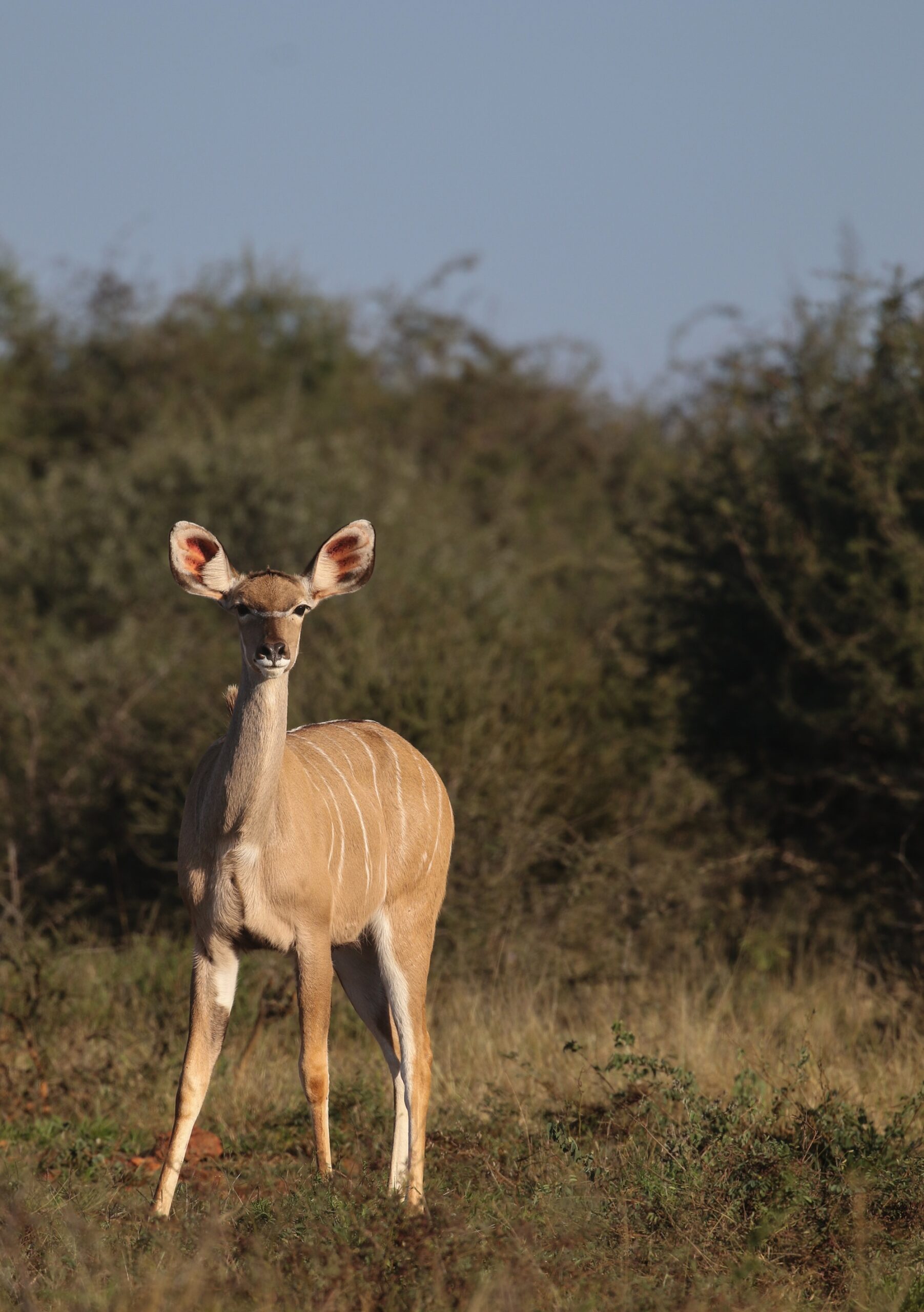
Why Do Kudus Have Such Big Ears?
The greater kudu is often admired for its elegant spiral horns and beautiful striped coat, but one of its most important features is often overlooked: its large ears.
These impressive ears provide excellent hearing, helping kudus detect predators long before they are seen. Lions, leopards, wild dogs, and hyenas all pose a threat, and in thick bushveld habitat visibility is often limited. Sensitive hearing allows kudu to remain alert even when feeding among dense vegetation.
The ears can rotate independently, allowing a kudu to pinpoint the direction of sounds without moving its head. This helps them identify potential danger while remaining as inconspicuous as possible.
Large ears may also assist in regulating body temperature. The network of blood vessels close to the skin can help release excess heat, an advantage during hot summer months.
Combined with their exceptional hearing, excellent sense of smell, and cautious nature, these adaptations help make kudu one of the bushveld’s most successful antelope species. Their ears are not simply decorative—they are essential survival tools.
The Scaly-feathered Finch: A Specialist of the Dry Bush
The scaly-feathered finch is a small bird that often goes unnoticed despite its striking appearance. Named for the delicate scale-like pattern across its plumage, this species is particularly well adapted to the dry savannas and thornveld regions of southern Africa.
Unlike many birds that rely heavily on insects, scaly-feathered finches are primarily seed eaters. Their strong, conical beaks are perfectly designed for cracking tough grass seeds, allowing them to thrive in arid environments where food can be limited.
They are commonly seen in pairs or small family groups and often forage quietly on the ground beneath shrubs and trees. Their subtle colouring provides excellent camouflage against the dusty landscape.
During the breeding season, these birds construct neat cup-shaped nests within thorny bushes, helping protect their eggs and chicks from predators.
Although they may not attract as much attention as larger or more colourful birds, scaly-feathered finches are a wonderful reminder that even the smallest species play an important role in the complex ecosystem of the African bush.